
The business landscape in 2026 is one of cautious yet determined optimism. Entrepreneurs are entering the year with strong confidence—74% anticipate increased revenue and nearly 60% plan to expand their operations. At the same time, growth is slower than in previous booms, and persistent cost pressures demand disciplined execution. The path forward is being defined by three clear pillars: strategic technology modernization, disciplined financial planning, and a deliberate, human-centered approach to talent.
This guide breaks down the proven strategies you need to increase your Business in 2026, complete with real-world use cases, a competitor comparison to sharpen your edge, and actionable insights.
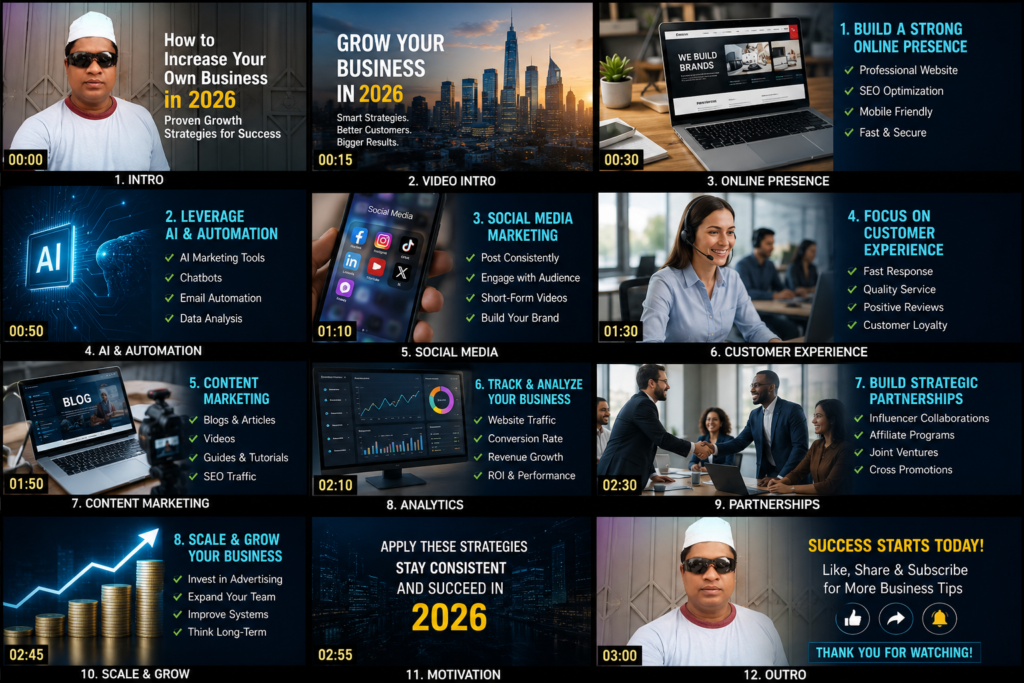
The Four Essential Pillars of Growth in 2026
Success this year hinges on focusing your energy where it will have the greatest impact. These four pillars form the core of a winning growth strategy.
Pillar 1: Adopt Purposeful AI and Technology – Technology modernization is a top priority for Business in 2026, with 81% planning upgrades this year. AI is at the heart of this shift. Currently, 58% of small Business in 2026 are using generative AI, and 82% of those report workforce growth as a direct result. The goal is not to chase every new tool, but to invest in AI that solves a specific problem: automating customer service, personalizing marketing, or streamlining inventory management. This approach is boosting productivity enough that global digital transformation spending is projected to reach $3.4 trillion.
Pillar 2: Strengthen Financial Discipline – In a year of slower GDP growth (forecast at 2.2% in 2026) and elevated interest rates, financial discipline is a competitive advantage. This means stress-testing your balance sheet, modeling best- and worst-case scenarios, and ensuring your credit structure can flex with demand. Strong cash flow management enables you to invest in growth opportunities without being derailed by economic headwinds.
162W Laptop Power Bank 27600mAh

100W Power Bank Devoted
65W Power Bank Fail

880W USB-C Charger Block

AOHI 140W PD3.1

AOHI 170W

Real Use Cases: From Challenge to Growth
Business in 2026 across the U.S. are turning challenges into opportunities. Here’s how.
Use Case #1: AI for Inventory Management
A small hardware retailer in Ohio struggled with manual stock checks and frequent out-of-stocks. By adopting an AI-driven inventory system with barcode scanning, they reduced manual errors, improved reordering efficiency, and increased sales of high-demand items by 15% in the first quarter.
Use Case #2: Digital-First Customer Experience
A boutique law firm in Texas replaced paper forms and phone scheduling with an online booking portal and automated client communication. The result was a 25% increase in new client consultations and reduced administrative overhead, allowing lawyers to focus on billable work.
Use Case #3: Hybrid Talent for Specialized Skills
A Chicago marketing agency needed data analysis skills but couldn’t find full-time candidates. They hired two freelance data specialists on a project basis, completing a complex analytics dashboard in weeks. This talent strategy fueled data-driven campaigns and boosted client retention by 30%.
Features and Benefits: What a Modern Business Strategy Delivers
Strategy Comparison: Finding the Right Approach
Pros
- Greater access to digital marketing tools
- AI improves productivity
- More opportunities for global reach
- Better customer insights through analytics
- Increased automation capabilities
- Growing online shopping market
Cons
- Increased competition
- Rising advertising costs
- Rapid technology changes
- Cybersecurity risks
- Constant need for content creation
- Higher customer expectations
The Competitive Landscape: Where to Invest Your Energy
Understanding the competitive landscape in 2026 starts with recognizing a fundamental shift: growth is no longer driven solely by market expansion, but by strategic positioning. While U.S. GDP is forecast to grow 2.2% this year, the difference between companies that thrive and those that merely survive will come down to execution on technology, talent, and customer experience.
Key competitors to watch include:
- Digital-First Competitors: These Business in 2026 are using AI to personalize interactions and optimize pricing in real-time.
- Talent-Attractive Firms: Companies offering remote flexibility and upskilling programs are pulling top talent away from traditional employers.
- Local, High-Touch Business in 2026: Authenticity and personal service remain powerful differentiators as digital saturation increases.
Frequently Asked Questions (FAQ)
1. What is the single most important investment for a small business in 2026?
The most important investment is strategic AI adoption. Purposeful implementation—such as AI for customer service, lead response, or inventory management—delivers the highest ROI. The 58% of U.S. small Business in 2026 already using generative AI and reporting workforce growth is a clear signal that this is a competitive necessity, not a luxury.
2. How can I find and retain talent when the labor market is so competitive?
Focus on flexibility and development. While competitive pay matters, creating a culture of recognition and offering professional development are key. Expanding your hiring pool to include freelancers and part-time specialists can also help you access hard-to-find skills without the overhead of full-time hires.
3. How do tariffs and inflation affect my growth plans, and what should I do?
Tariffs and inflation are top concerns, cited by 64% and 70% of Business in 2026 owners respectively. Mitigate these risks by stress-testing your cash flow, modeling best- and worst-case scenarios, and reducing reliance on single-source suppliers. Business in 2026 with strong financial fundamentals are using discipline to identify opportunities, even during uncertainty.
Final Verdict: Your 2026 Growth Roadmap
To grow your business in 2026, you must execute on a disciplined, multi-front strategy:
- Adopt one AI tool this quarter. Identify a single, repetitive task it can automate. Measure the time saved and redeploy that resource.
- Strengthen your financial backbone. Review your cash flow statements and identify cost leakages. Build a “what-if” scenario model for potential economic shifts.
- Make talent your priority. Conduct a skills audit of your team. Identify the one skill gap you need to fill and explore freelancer platforms or a focused training program.
- Own your digital presence. Audit your Google Business in 2026 Profile, Yelp, and social media accounts for consistency. Optimize your site for AI and voice search.
The outlook for 2026 is one of cautious optimism. A predicted 2.2% GDP growth will demand that Business in 2026 owners act with purpose and discipline. By mastering these strategies, you will not only survive—you will lead.