
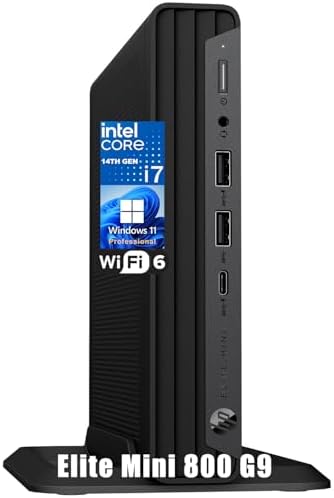
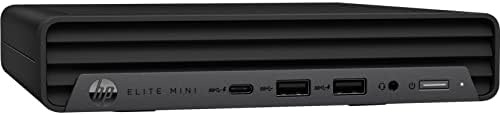

Best Desktop Computers For Business: HP Elite Mini 800 G9, 14th Gen Intel 20-Core i7

Best Desktop Computers for Business in 2026: A US Buyer’s Guide
Meta title (58 chars): Best Desktop Computers for Business in 2026 | US Buyer Guide Meta description (156 chars): Compare the best business desktop computers for US offices in 2026—towers, mini PCs, all-in-ones, and workstations—with specs, pricing, and pros and cons. Suggested slug: best-desktop-computers-for-business Primary keyword: best desktop computers for business Secondary keywords: business desktop PC, office computer 2026, small business computers, vPro desktop, mini PC for business, Windows 11 Pro desktop
The 2026 Business Desktop Market, in One Sentence
If your office is still running machines bought before 2019, the decision has already been made for you.
Microsoft ended support for Windows 10 on October 14, 2025. Extended Security Updates are available in one-year increments through October 2028, but the pricing is punitive by design—roughly $61 per device for the first year, doubling each year after, and the cost is cumulative, so enrolling late means paying for the years you skipped. For most US businesses, three years of ESU on a fleet of 40 machines costs more than replacing them.
That deadline collided with a second shift: neural processing units. Business desktops shipping in 2026 increasingly include on-chip NPUs, with commercial micro desktops now reaching around 50 TOPS of local AI performance, compared with 10–20 TOPS on the previous generation. Whether your team uses that today is almost beside the point. A desktop bought in 2026 will likely still be on the books in 2030, and NPU-equipped hardware is the difference between a fleet that can adopt local AI tooling and one that can’t.
So the question isn’t whether to refresh. It’s what to buy.
How to Choose: Five Criteria That Actually Matter
1. Form factor should follow the room, not the spec sheet.
The traditional mini-tower still makes sense under a desk, but it’s no longer the default. Manufacturers now ship the same computing power across mini towers, thin desktops, and compact small-form-factor cases. Three categories have grown fastest:
- Mini/micro PCs (roughly 1 liter): VESA-mount behind a monitor. Ideal for reception desks, exam rooms, hot desks, and kiosks.
- All-in-ones: Monitor and system in one unit. Cheaper LCD panels and power-efficient components have made these a legitimate office choice rather than a compromise.
- Small form factor towers: The middle ground—some expansion, half the volume of a mini tower.
2. Set a realistic 2026 configuration floor.
Sixteen gigabytes of RAM and a 512 GB SSD are the sensible minimum for a new business PC in 2026. For machines you intend to keep five years, or for users who live in 30 browser tabs plus Teams plus a database client, 32 GB and 1 TB are the safer defaults. On the CPU side, an Intel Core i5 / Core Ultra 5 or AMD Ryzen 5 is the practical entry point.
The cost difference between 16 GB and 32 GB at purchase is small. The cost of a technician opening 40 machines in year three is not.
3. Insist on Windows 11 Pro and vPro-class management.
Business buyers should specifically look for vPro processors, Windows 11 Pro, and TPM 2.0 for security and remote management. Windows 11 Home cannot join a domain, cannot use BitLocker management properly, and cannot be managed through Intune the way Pro can. Buying a home to save $60 per seat creates a problem your IT provider will bill you to solve.
Windows 11 24H2 requires TPM 2.0, Secure Boot, and a supported CPU—Intel 8th Gen or AMD Zen 2 at minimum. Any new commercial desktop clears that bar comfortably; used and refurbished stock may not.
4. Buy the warranty, not just the box
Next business day onsite hardware support is the single highest-value line item on a commercial quote. A desktop that dies on a Tuesday and gets fixed on Wednesday costs you almost nothing. The same failure on a consumer machine means a shipping label and two weeks of a spare laptop.
5. Price the total cost, not the sticker.
Base-configuration prices you see advertised are observations, not guarantees. Taxes, business support tiers, Windows edition, volume agreements, and configuration changes all move the final number. Get a quote for the actual configuration, in the actual quantity, with the actual warranty term.
The Best Business Desktops for US Offices in 2026
Best overall: Dell Tower Plus (EBT2250)
The Dell Tower Plus is the machine that fits the most desks without compromise. Reviewers consistently rank it as the strongest all-around business tower of 2026, praising its configuration flexibility, internal expandability, and quiet operation. It scales from a straightforward Core Ultra 5 office box up to Core Ultra 9 285K with RTX 5080 graphics, 64 GB of DDR5, and 4 TB of SSD storage—which means one SKU can serve both your accounting team and your marketing designer.
Pros: Configurations for nearly every use case; genuine internal expansion room; quiet under load; strong US business support network. Cons: Takes real desk or floor space; higher-end configurations get expensive quickly; overkill for pure email-and-spreadsheet users.
Best value: Apple Mac mini (M4)
For Apple-centric offices—agencies, design studios, media production, and increasingly law and consulting firms—the Mac mini with M4 is difficult to argue against. At its price point, it offers performance that’s hard to match in a compact, well-built chassis. The M4 Pro variant handles video editing and large dataset work that would demand a much larger Windows tower.
Pros: Outstanding performance per dollar, tiny footprint, excellent build quality, low power draw, and near-silent operation. Cons: Not suitable for gaming or CUDA-dependent workloads; front USB-C ports run slower than the rear ports; awkward power button placement; RAM and storage are not user-upgradeable, so you must buy the configuration you’ll need in year four.
Best compact business PC: Lenovo ThinkCentre M70q / Neo Tiny series
The ThinkCentre Tiny line is the workhorse of American open-plan offices. Testers note that it loads Excel, Zoom, and web apps with minimal delay, mounts behind a monitor for a tidy all-in-one feel, and includes enterprise-level connectivity such as dual display outputs and Wi-Fi 6E. For a 25-person office that needs identical, manageable, space-efficient machines, this is the path of least resistance.
Pros: VESA mounting; dual display output; strong Lenovo fleet management tooling; low acquisition cost per seat. Cons: Integrated graphics only; limited internal expansion; external power brick offsets some of the space saving.
Best all-in-one: Lenovo ThinkCentre M90a Pro Gen 6
All-in-ones earn their place at reception desks, in clinics, and in conference rooms where cable management is a visible part of the customer experience. The M90a Pro Gen 6 brings commercial-grade manageability to that form factor rather than repackaging a consumer AIO.
Pros: One power cable, zero visible tower, touch options, and a clean aesthetic for client-facing spaces. Cons: The display and system are tied together—a failure in either means replacing both; upgrade paths are limited; you pay a premium over a mini PC plus a separate monitor.
Best workstation: Dell Pro Max Tower T2
When the workload is engineering, data modeling, machine learning, or 3D rendering, a business desktop is the wrong tool and a workstation is the right one. The Pro Max Tower T2 is specced for exactly those jobs, with ISV certifications, professional GPU options, and ECC memory support.
Pros: Handles workloads that would choke a standard tower; certified for professional software; built for sustained full-load operation. Cons: Significantly more expensive; physically large; wasted money for anyone not running the workloads it’s designed for.
Best compact professional machine: HP Z2 Mini G1a
The Z2 Mini bridges two categories that usually don’t meet: workstation-class capability and a footprint small enough to mount behind a display. For CAD users in tight offices or engineering teams in shared labs, it removes the usual tradeoff.
Pros: Workstation performance in a compact chassis; professional GPU options; HP’s commercial security and management stack. Cons: Thermally constrained under sustained all-core load; premium pricing; limited internal expansion compared with a full tower.
Best budget Option: entry Dell / HP / Acer business towers
Not every seat needs a flagship. Entry business towers with a Core i3 or Ryzen 3, 8–16 GB of DDR5, and a 256–512 GB SSD run Microsoft 365 and browser workflows perfectly well, and Dell budget towers under $700 remain competitive in 2026.
Pros: Low cost per seat; still supports Windows 11 Pro and TPM 2.0; adequate for reception, POS, and single-application roles. Cons: Thin headroom—these age out faster; often fewer ports and slower storage; consumer-tier warranty unless you upgrade it.
Desktop vs. Laptop: Pros and Cons for US Businesses
Pros of choosing desktops
- Better performance per dollar. Desktops deliver superior performance per dollar compared to laptops, along with easier upgradability and better ergonomics for permanent workstations.
- Multi-monitor capability out of the box. Desktops are the natural fit for roles requiring multiple displays, intensive processing, or specialized peripherals—finance, dispatch, design, and healthcare.
- Longer service life. No battery to degrade, better thermals, and larger cooling mean less throttling and fewer heat-related failures over five years.
- Cheaper to repair. Standardized components and tool-less chassis designs mean a failed drive or RAM stick is a fifteen-minute fix, not a board-level replacement.
- Harder to lose. A desktop doesn’t get left in an airport. For regulated industries, that’s a real security and compliance advantage.
- Easier to standardize. One image, one driver set, and one spare parts bin across an entire fleet.
Cons of choosing desktops
- Zero portability. Hybrid schedules are now standard in most US offices, and a desktop simply can’t follow a worker home.
- Requires a full peripheral set. A monitor, keyboard, mouse, and often a webcam and headset add meaningfully to the per-seat cost.
- Desk and floor space. Real estate is expensive; a mini tower per employee is a genuine facilities cost in dense offices.
- Power dependency. No battery means a brownout is an interrupted workday unless you budget for UPS units.
- Slower to deploy remotely. Shipping and setting up desktops for remote staff is more work than mailing a laptop.
- Harder to justify for mobile roles. Sales, field service, and executive staff will need a laptop regardless, which can leave you supporting two hardware standards.
Buying Recommendations by Business Type
| Business type | Recommended pick | Suggested config |
|---|---|---|
| Small office, 5–25 seats | Lenovo ThinkCentre Tiny or HP Mini | Core i5 / Ryzen 5, 16 GB, 512 GB |
| Accounting / legal / insurance | Dell Tower Plus | Core Ultra 5–7, 32 GB, 1 TB |
| Reception, clinic, retail POS | All-in-one or mini PC | Core i3–i5, 16 GB, 256–512 GB |
| Creative and media | Mac mini M4 Pro or Dell Tower Plus with RTX | 32–64 GB, 1–2 TB |
| Engineering / CAD / data science | Dell Pro Max Tower T2 or HP Z2 Mini | 64 GB+, pro GPU, 2 TB |
| Budget-constrained | Entry Dell/HP business tower | Core i3, 16 GB, 512 GB |
The Bottom Line
There is no universal best business desktop. The right choice depends on whether the machine will run Microsoft 365 and browser applications, support a managed fleet, drive professional graphics software, fit behind a monitor, or replace an entire reception-desk workstation.
For most US businesses in 2026, the honest answer is a mix: mini PCs for the majority of seats, a handful of towers for power users, an all-in-one or two for client-facing spaces, and a workstation only where the workload genuinely demands it. Standardize on Windows 11 Pro, specify vPro where you can, buy 16 GB minimum and 32 GB where it matters, and add next-business-day onsite coverage.
Do that once, and you won’t be having this conversation again until 2030.
Frequently Asked Questions
Do I still need to worry about Windows 10 end of support? Yes. Support ended October 14, 2025. Extended Security Updates run through October 2028 at escalating, cumulative per-device pricing, which makes them a stopgap rather than a strategy. Any machine that can’t upgrade to Windows 11 is by definition seven or more years old and past sensible refresh age.
How much RAM does a business desktop need in 2026? 16 GB is the sensible floor; 32 GB is the safer default for long ownership and heavy multitasking. Pair it with a 512 GB SSD minimum, 1 TB if the machine will be in service for five years.
Is a mini PC powerful enough for real business work? For office suites, browsers, accounting software, and video calls, yes—modern mini PCs are genuine desktop replacements for almost all business tasks. They fall short only on discrete-GPU workloads like 3D rendering, heavy video editing, and CAD.
What is vPro, and do I need it? Intel vPro is a set of business management and security features that allow IT to update, repair, and secure machines remotely, even when the OS won’t boot. For fleets of 20 or more, or any organization with compliance obligations, it pays for itself quickly.
Are all-in-ones a bad investment? Not bad, just specific. They save space and look clean in client-facing areas, but tying the display to the system limits upgrades and turns any single-component failure into a whole-unit replacement.
Mac or Windows for a small business? Follow your software. If your core applications are Microsoft 365, industry-specific Windows software, or anything requiring domain management, choose Windows. If your work is design, media, or development on a Mac-standardized team, the Mac mini is excellent value.
bswissbswiss –
HP Elite Mini 800 G9 is a WINNER!
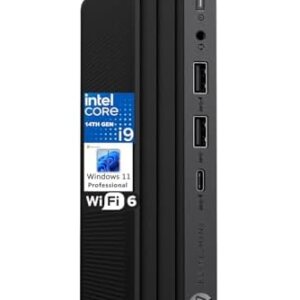
This tiny box has all the memory capacity, speed, and sturdiness you’d find in a big tower. Definitely a major space saver that is well designed with adequate ventilation that keeps it running cool with absolutely no noise. It was super easy to set up. The onboard graphics is more than capable of handling the type of games I own because they are not memory hogs. The seller/shipper had the delivery at my door in two days. Everything worked perfectly right out of the box. Very pleased with the ease of setup, build quality, true build description and speed this small powerhouse delivers.
One person found this helpful
Roger G. –
Nice computer
Fast computer and easy to set, despite its small form factor. I am happy so far.
Bill & Nancy Page –
Love this Design
Love the compact size, super fast , runs real cool too!
Timothy Gibb –
Excellent Value
Excellent replacement for much larger PC. Amazing that so much exists in such a small pc. I bought the new Intel I9 chip, 64 gig of Ram, 2TB storage, with plenty of USB ports and all other ports needed to setup a monitor, sound system, video/mic for Zoom calls, keep board, physical internet and wireless connection, and everything else packed into this small tower.
CM –
Solid
So far so good. Nice and snappy. Good sound and video. Very good performance for the money. Make surenit has good power hookup or it may shut off.
Zibberzoo –
Quiet!
Quiet and powerful. No serious complaints (not tied to Windows 11).
Rev Dale Durnell –
Great things in small packages.
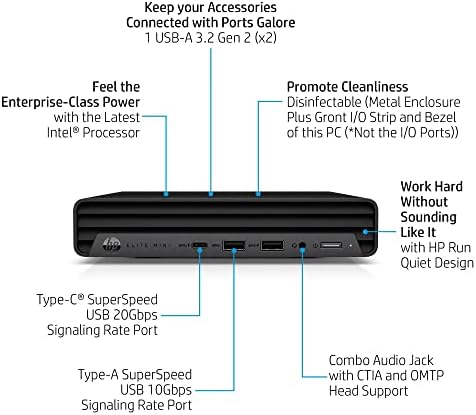
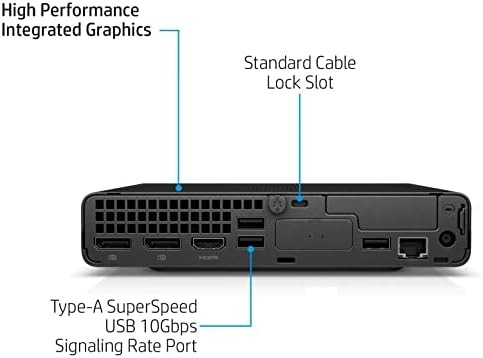
My personal desktop machine is a Dell XPS-8940 with an 11th Gen Intel i9-11900 with 32 GB of RAM. This HP Elite Mini 800 G9 is a dynamo in a small footprint, with a 14th Gen Intel 20-Core i7-14700 that came with 64 GB of RAM.It’s got three monitor ports, which will support three monitors. And it’s got USB ports coming out your ears. Alas, none of the USB’s are blue, so I can’t tell if any of them are USB 3.It’s so small, I’m glad it came with a place to secure it with a cable lock; this is smaller than many laptops. My preference is always a stand alone graphics card, but the Intel integrated 700 graphics is working just fine. And, for what it will be used for, even dedicating some of the 64 GB available should never be a problem.
7 people found this helpful
Sak –
Built-in Wi-Fi Option “Off” Not Available During Initial Setup Process
My wife was so excited when the computer arrived, but the initial setup process was disappointing. Before purchasing the computer, I verified it had built-in Wi-Fi feature. During the initial computer setup process, the first few steps were going fine until needing the Internet connection via Ethernet or Wi-Fi. That is when the setup became difficult. The setup screen showed Wi-Fi “Off” as default where no available Access Points to select. Hence, I was unable to used Wi-Fi to complete the setup. I spent an hour troubleshooting this issue. Finally, I disconnected the computer and moved to a location where I had an Ethernet connection. After completing the initial computer setup process with Windows updates, I was able to used the built-in Wi-Fi feature. Otherwise, this is a great mini desktop computer but initial setup not so simple for non-techies.
16 people found this helpful
Dante Américo Bonessi –
Calidad del producto
Excelente producto
Innusik –
Quick little devil
This small comp is quick. Did not have any problem. I bought Dell first, but got defective audio port and it was very hot. So I return Dell and bought HP . This is works perfectly so far. Like that there is a stand and comp steady mount vertically. It also became warm, but not so hot as Dell. I have only one issue, there is no enough USB ports on a back side. Definitely not enough to connect keyboard, mouse, speakers and cameras. I had to buy USB multiplier, so this is teason that I put 4 stars.
2 people found this helpful
Bill & Nancy Page –
Love this Design
Love the compact size, super fast , runs real cool too!
Bill & Nancy Page –
Love this Design
Love the compact size, super fast , runs real cool too!
Bill & Nancy Page –
Love this Design
Love the compact size, super fast , runs real cool too!
Bill & Nancy Page –
Love this Design
Love the compact size, super fast , runs real cool too!
Bill & Nancy Page –
Love this Design
Love the compact size, super fast , runs real cool too!